

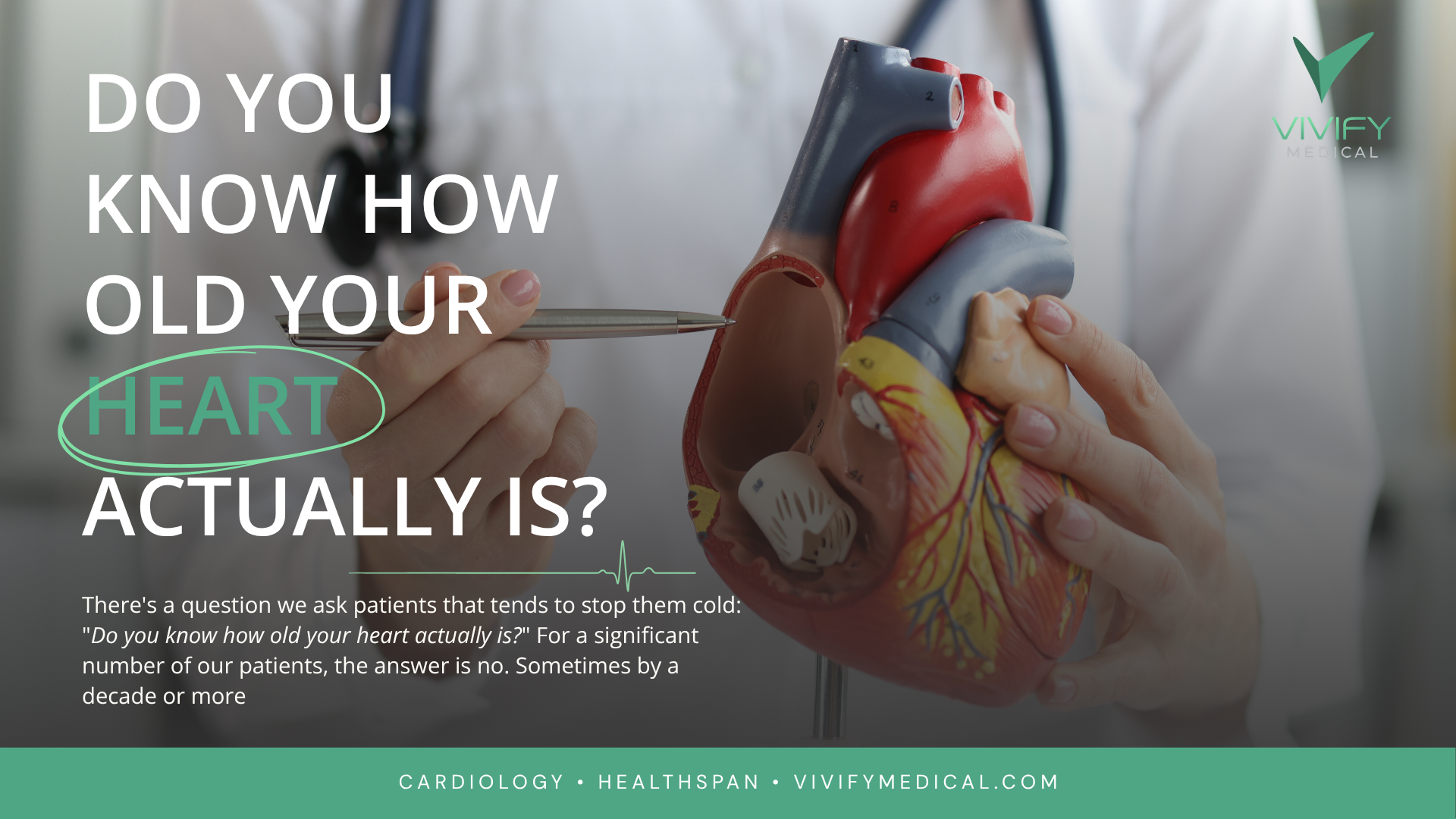
Do you know how old your heart actually is?
That gap between your chronological age and how your cardiovascular system functions is what we call heart age. Unlike many health metrics, it is both measurable and potentially changeable. That's what makes it worth understanding.
Why Your Heart Ages Differently Than You Do
Your cardiovascular system ages based on what it's been exposed to, not how many birthdays you've had. Blood pressure that's run slightly high for years. Inflammatory markers quietly elevated from chronic stress or diet. Cholesterol that looks "borderline fine" on a basic panel but tells a more complicated story when you look deeper. Sleep deprivation. Weight that's accumulated slowly enough that no single year felt alarming.
None of these things feel like emergencies. Most of them don't feel like anything at all. That's the particular danger with cardiovascular disease: it is extraordinarily quiet in its early stages. For some people, the first obvious symptom of cardiovascular disease is a serious event such as a heart attack.
If cardiovascular disease develops quietly over decades, prevention has to begin long before symptoms appear.
What Preventive Cardiology Actually Means in Practice
Preventive cardiology is built on a simple idea: cardiovascular disease doesn’t appear overnight. It develops over years, often decades. That timeline creates an opportunity to identify risk early and change its course.
At Vivify Medical, prevention starts before symptoms. We’re not only asking whether your heart is healthy today; we’re asking what your cardiovascular health may look like five, ten, or twenty years from now. That requires more than a routine exam. It means building a complete picture of your health through advanced testing, medical history, lifestyle factors, and ongoing clinical oversight.
That picture may include:
Comprehensive cardiovascular risk assessment
Not a checklist, but an in-depth conversation about family history, metabolic health, habits, symptoms, and long-term goals.
On-site echocardiograms
Helping evaluate heart structure and function in real time, allowing potential concerns to be identified earlier without unnecessary delays.
Stress echocardiograms
Helping assess how the heart performs under physical demand, where certain abnormalities may become more apparent.
VO2 max testing (coming soon to our practice)
One of the strongest measurable indicators associated with cardiovascular fitness, longevity, and overall health trajectory. Once we have that number, your physician builds a plan around it: exercise intensity, recovery, and progression tailored to where your fitness actually is.
Integrated primary care and cardiology
Because prevention works best when physicians see the full picture rather than isolated conditions.
Modern healthcare is often divided into silos: a primary care physician managing one issue, a specialist managing another, and patients left coordinating everything in between. Important patterns can be missed when no one is looking at the full picture.
Vivify Medical was built to work differently, bringing prevention, primary care, and cardiology together around one patient rather than treating separate conditions in isolation.
What Is Heart Age?
Heart age is a way of expressing cardiovascular risk in terms that are easier to act on than abstract percentages. It takes into account your blood pressure, cholesterol, weight, smoking history, family history, and other factors to estimate the biological age of your cardiovascular system.
A 45-year old with a heart age of 55 may have the cardiovascular risk profile of someone a decade older. The opposite can also happen: a 50 year old with a heart age of 42 may have built protective habits that lowered long term risk.
What the number tells us isn't fate. It tells us where to focus. And that focus can change the trajectory.
How Weight Influences Heart Age
One of the most significant contributors to accelerated cardiovascular aging is weight, not because of aesthetics, but because of what excess weight does to the heart mechanically and metabolically over time. It raises blood pressure. It affects how the heart fills. It contributes to inflammation. It changes how the body handles blood sugar.
We integrate weight management into cardiology care because improvements in weight often improve cardiovascular risk factors as well. Blood pressure, inflammation, insulin resistance, and even heart age can improve over time. Sustainable weight management can meaningfully improve cardiovascular risk factors over time, often without extreme interventions.
Longevity Isn't Just About Living Longer
There's a word that's become important in conversations about aging: healthspan. It's the distinction between the number of years you live and the number of years you live well, without medication-dependent decline, without limitation, without spending your 70s managing the consequences of what your 40s ignored.
The heart is central to this conversation because cardiovascular health underpins almost everything else. Your energy. Your cognitive function. Your ability to move. Your recovery from illness. Improving heart age is not simply about changing a number. It is about protecting the quality of the decades ahead.
Understanding your heart age may offer a clearer picture of your long term cardiovascular risk and where prevention could make the greatest difference. Sometimes the most important findings come before symptoms ever appear.
📍 Manhattan | 💻 Now accepting new patients
👉www.vivifymedical.com | 📞 212-480-9500