

The Modern Men's Health Paradox: When Performance Masks Risk
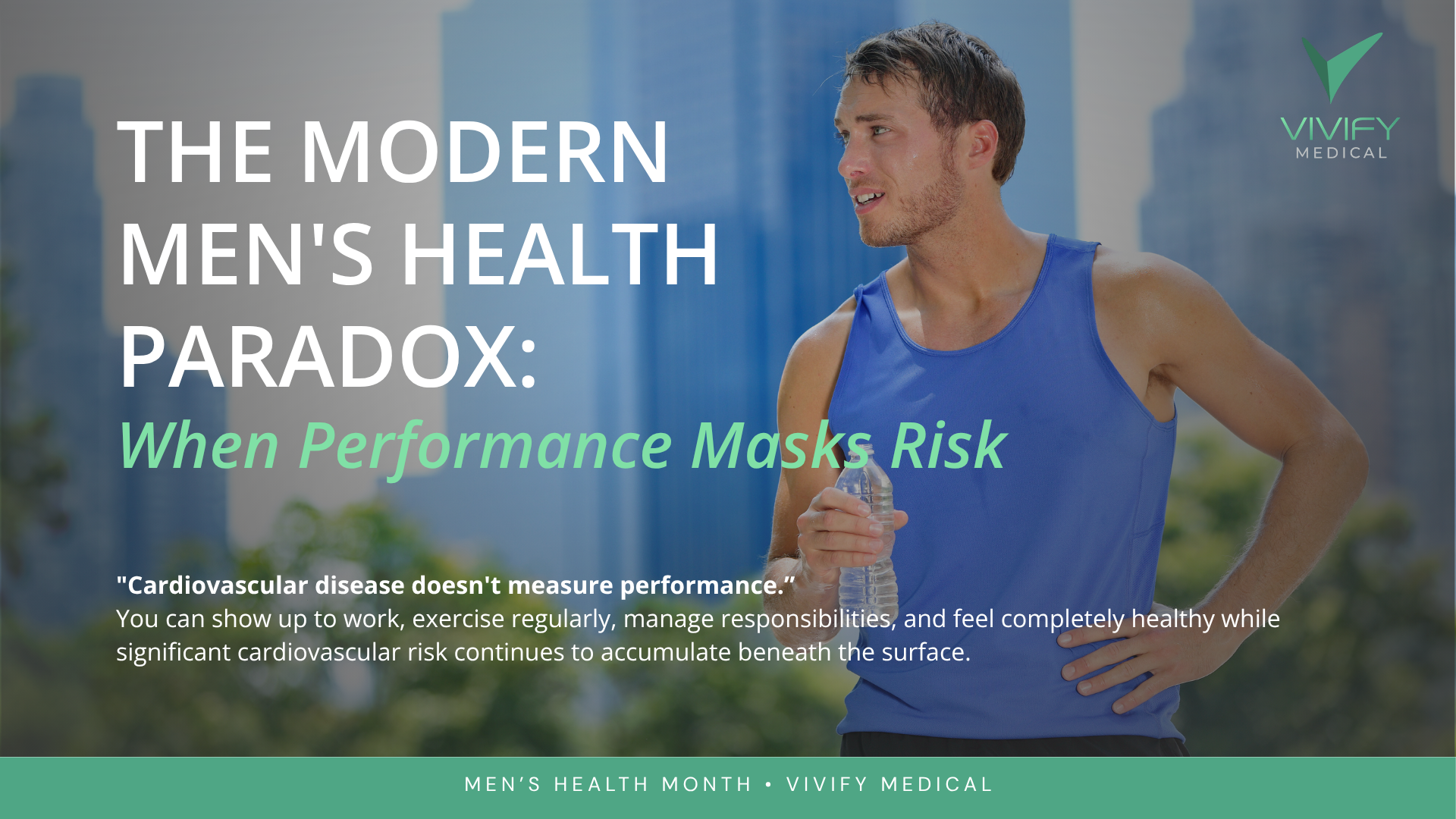
Many men assume that if they feel well, function well, and maintain an active lifestyle, their cardiovascular health must be intact. They show up to work, exercise regularly, travel, manage responsibilities, and keep moving forward. The problem is that cardiovascular disease does not measure performance.
The heart doesn't always send warnings. High cholesterol, inflammation, plaque buildup, and elevated blood pressure can develop quietly for years, long before they affect how you feel or perform. The cardiovascular system is remarkably effective at compensating, which means that by the time something feels wrong, the underlying process is often well established.
Feeling healthy and being heart healthy are not always the same thing.
The risks you can't feel
One of the most persistent misconceptions in cardiovascular medicine is that serious risk factors eventually make themselves known. They often don't.
A man can maintain a healthy weight, exercise consistently, and feel entirely well while significant cardiovascular risk continues to accumulate beneath the surface.
Elevated Lp (a), ApoB, and LDL cholesterol can quietly build plaque inside arterial walls for years before any symptoms appear. High blood pressure may cause progressive vascular damage without ever producing a headache or a warning sign you would notice. Insulin resistance can place chronic metabolic stress on the cardiovascular system years before diabetes develops. Chronic low-grade inflammation, one of the more underappreciated drivers of heart disease, may accelerate arterial injury without affecting how you feel on any given day.
The absence of symptoms is not evidence of cardiovascular health. Many of the factors most closely associated with heart attack and stroke are detectable only through appropriate testing, which means that how you look, how you perform, and even how you feel may not tell the full story.
The modern men's health paradox
Many of the men at highest cardiovascular risk do not fit the traditional image of an unhealthy patient. They are productive, engaged in their careers, physically active, and capable of meeting the demands placed on them every day.
That is precisely what makes risk difficult to recognize.
Cardiovascular health is shaped not only by exercise and diet, but also by the cumulative effects of stress, sleep, recovery, and metabolic health. The realities of modern professional life can quietly undermine these systems over time, even in individuals who appear healthy by conventional standards.
Chronic stress has been associated with elevated cortisol levels, higher blood pressure, and systemic inflammation. Inadequate or fragmented sleep disrupts glucose regulation and interferes with the physiological recovery processes that support cardiovascular function. The American Heart Association recognizes sleep as a core component of cardiovascular health, alongside blood pressure, cholesterol, blood glucose, physical activity, and other established risk factors.
Prolonged periods of sitting have also been associated with increased cardiovascular risk independent of formal exercise. Exercise capacity matters as well. Measures such as VO₂ max, which reflects how efficiently the body uses oxygen during physical activity, have been strongly associated with cardiovascular health and long-term outcomes. Yet even favorable fitness metrics do not eliminate the need to evaluate other forms of cardiovascular risk.
Chronic occupational stress and burnout deserve particular attention. Sustained psychological stress has been associated with changes in inflammatory activity, autonomic nervous system regulation, and cardiovascular function. These changes may have important implications for long-term cardiovascular health and are not always apparent during a routine medical evaluation.
Perhaps the greatest challenge is that many men interpret their ability to keep performing as evidence that nothing is wrong. They define health as the absence of symptoms and assume that if they can continue meeting their responsibilities, their cardiovascular health must be intact.
Unfortunately, cardiovascular disease does not always announce itself before it becomes clinically significant.
Seeing the full picture
If cardiovascular risk can develop silently, the next question becomes obvious: how do you find it before symptoms appear?
The answer is rarely a single number.
A standard cholesterol test is an important part of cardiovascular screening, but it captures only a small part of what influences long-term cardiovascular risk. The factors that contribute to heart disease rarely exist in isolation. They interact across multiple systems, and understanding that interaction often requires looking beyond a single laboratory value.
At Vivify Medical, comprehensive cardiovascular blood work evaluates several biological markers that can provide a more complete picture of long-term cardiovascular risk, including:
ApoB— a measure of the number of atherogenic lipoprotein particles circulating in the bloodstream, providing additional insight into cardiovascular risk beyond standard cholesterol measurements.
Lipoprotein(a) [Lp(a)] — A genetically inherited cholesterol-related particle that is increasingly recognized as one of the strongest independent risk factors for cardiovascular disease. Elevated Lp(a) levels can contribute to plaque formation, inflammation, and blood clotting, increasing cardiovascular risk even in otherwise healthy individuals. Because Lp(a) is largely determined by genetics, lifestyle alone may not significantly reduce elevated levels, making testing particularly important for risk assessment.
Advanced lipid testing— a more detailed assessment of lipid-related risk factors than a traditional cholesterol panel.
Fasting glucose and HbA1c— markers used to evaluate blood sugar regulation and identify insulin resistance or prediabetes.
High-sensitivity C-reactive protein (hs-CRP) — an inflammatory marker associated with cardiovascular risk.
Kidney and liver function testing — important because both organs influence cardiovascular health, metabolic function, and medication management.
Thyroid and selected hormonal markers — tests that may provide additional context for cardiovascular and metabolic health.
Viewed individually, each result provides a piece of information. Evaluated together and tracked over time, they can help establish a more complete picture of cardiovascular risk and support more personalized prevention strategies.
For many men, the greatest value is not a single laboratory result. It is establishing a baseline, a clear understanding of where things stand today, so that meaningful changes can be identified early and informed decisions can be made before symptoms ever develop.
How do you find a problem that doesn't cause symptoms?
One of the most common assumptions in cardiovascular health is also one of the most misleading: "I'd know if something were wrong."
Not always.
Many cardiovascular abnormalities do not become apparent until the heart is placed under stress. A person may feel entirely well at rest while underlying problems remain undetectable in daily life. The heart is remarkably effective at compensating for early dysfunction, which is why significant cardiovascular disease can develop long before symptoms appear.
This is where cardiac stress testing becomes valuable:
A Standard Stress Test monitors the heart while you exercise on a treadmill, evaluating heart rhythm, blood pressure, and exercise capacity as physical demand increases. It is often the right starting point for men who have never had a formal cardiac evaluation.
A Stress Echocardiogram adds ultrasound imaging before and immediately after exercise, allowing physicians to assess how the heart muscle functions under load. This can detect reduced blood flow to specific regions, structural abnormalities, and changes in pumping efficiency that only appear when the heart is working hard. It is one of the most informative non-invasive cardiac tests available.
Neither test is reserved for people who feel unwell. Their greatest value often comes from identifying potential concerns before symptoms develop.
Prevention Works Best Before You Need It
The most effective cardiovascular care is often the care that prevents a problem from becoming an emergency.
When risk factors are identified early, the range of available options is typically much broader. Elevated Lp (a), ApoB, abnormal glucose metabolism, hypertension, and other contributors to cardiovascular disease can often be addressed long before they lead to a cardiac event.
The goal is not to create anxiety. It is to replace assumptions with information.
If you are active, healthy, and have never had a comprehensive cardiovascular evaluation, that is not necessarily a reason to wait. It may be the best reason to start.
Schedule a Cardiovascular Evaluation
Vivify Medical combines advanced blood testing, stress testing, and personalized cardiovascular assessment to help patients understand their cardiovascular risk before symptoms develop.
Call 212-480-9500 or book online at vivifymedical.com. Located at 125 Maiden Lane, Suite 6B, New York, NY.